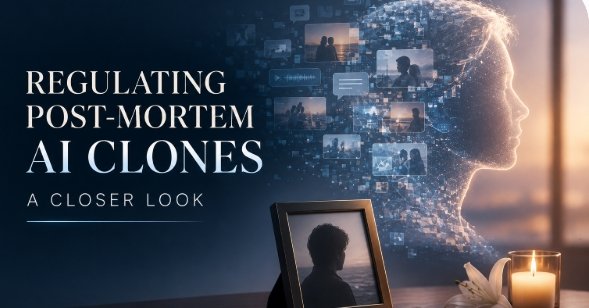
Generative AI has turned a person’s biography, voice recordings and old photographs into raw material for something new: a digital clone that can keep talking long after the person behind it has died. Museums now let visitors converse with recreations of war veterans, and a “grief tech” industry has grown around letting people speak with departed relatives. The technology has outpaced the law meant to govern it, and the gap is becoming harder to ignore.
PUBLICITY RIGHTS
- The closest existing protection is the right of publicity, a legal doctrine that gives a person control over the commercial use of their voice, image and likeness. A number of US states, including California and Texas, recognise a post-mortem version of this right, allowing it to survive a person’s death and pass to their estate. None of these statutes were drafted with AI cloning in mind, so courts and practitioners are left to stretch decades-old language onto a technology its authors never anticipated.
- The doctrine’s core limitation is that it was built around commercial exploitation. Historically, publicity rights have mattered most for people whose likeness carries market value, such as actors, musicians and other public figures, and the statutes are typically triggered by uses like advertising or merchandising. Most ordinary people have little commercial value attached to their image, so post-mortem publicity claims are rarely brought on behalf of private individuals, leaving their families with few legal levers to control an AI clone created after death.
- That gap matters more as cloning becomes technically easier and commercially available to non-celebrities. This is a structural mismatch: a right designed to stop unauthorised T-shirts and endorsements does not map cleanly onto a chatbot trained to reproduce a deceased parent’s speech patterns for a subscription-paying user.
REFRAMING PUBLICITY AS PRIVACY
- One proposed fix is to treat post-mortem likeness protection as a privacy interest rather than a purely commercial one. Publicity rights for the living already carry a privacy dimension, but the law has traditionally treated the dead as having little to no privacy interest left to protect, on the theory that a person can no longer be personally affronted once they are gone.
- AI cloning technology unsettles that assumption because it can reproduce a person’s mannerisms, opinions and speech patterns with a level of accuracy that earlier likeness uses, such as a photograph or a lookalike actor, never approached. That precision is the basis for arguing that a distinct privacy-style interest should survive death, independent of whether the deceased person’s likeness ever had commercial value while they were alive.
- Reframing the right this way would extend protection to people who were never public figures, which is where the current doctrine is weakest. It would also shift the legal question from “did this use exploit a commercially valuable likeness” to “did this use accurately reproduce a real person without consent,” a test that is arguably better suited to conversational AI clones than to traditional merchandising disputes.
THE NO FAKES ACT: A FEDERAL RIGHT TAKES SHAPE
- The most significant legislative response now moving through Congress is the NO FAKES Act (Nurture Originals, Foster Art, and Keep Entertainment Safe Act), which would create the first federal intellectual property right over a person’s voice and visual likeness. The Senate Judiciary Committee advanced the bill unanimously in June 2026, sending it to the full Senate with backing from a coalition spanning the entertainment industry, the recording industry and major technology companies. A House companion bill has also been introduced, though it has not yet been taken up in committee.
- Under the current text, the right would extend to every individual, not only public figures, and would survive death for 70 years, subject to renewal by the deceased’s heirs, executors or assignees if the likeness is being actively and lawfully commercialised. The bill would impose liability on people and companies who produce or distribute unauthorised digital replicas, and on platforms that knowingly host them, borrowing a notice-and-takedown structure from the Digital Millennium Copyright Act.
- A significant, and still unresolved, feature of the bill is federal pre-emption. As drafted, it would pre-empt future state laws on digital replicas while leaving existing state statutes, such as Tennessee’s ELVIS Act, intact. This split can create real uncertainty about how a federal right will interact with the patchwork of state publicity and privacy laws already on the books, and how courts should resolve conflicts between the two layers.
- The bill also carves out exceptions for commentary, criticism and biographical works, echoing the traditional publicity-rights distinction between selling merchandise using a person’s face, which is generally actionable, and producing something like a documentary or biopic about them, which is generally protected. Whether an AI clone built to simulate ongoing conversation falls on either side of that line, or somewhere in between, remains an open question that will likely need to be litigated once the statute is in force.
WHERE INDUSTRY IS FILLING THE GAP
- In the absence of settled law, some companies building digital-twin and grief-tech products have begun adopting their own internal rules. Industry figures report that a meaningful share of these projects involve recreating someone who has already died, and some operators say they decline to build clones for advertising or marketing use even where the law would not currently stop them.
- There is growing interest, without consensus, in an opt-in or opt-out mechanism that would let a living person register in advance whether they consent to being cloned after death, similar in concept to organ donation registries. No standardised industry framework of this kind currently exists, and adoption so far has depended on individual companies’ internal ethics policies rather than any binding external standard.
CONCLUSION
-
For now, anyone advising on this area is working with an unsettled and overlapping set of tools: state right-of-publicity statutes that were not designed for AI, a federal bill that has cleared committee but not yet become law, and a handful of company-level policies that carry no legal force outside the companies that adopt them. Until the NO FAKES Act, or something like it, is enacted and tested in the courts, the safest practical position for both individuals and businesses building these tools is to treat consent, whether given during life or by an estate after death, as the operative standard, rather than relying on the commercial-use trigger that has defined publicity law until now.
Authors: Shantanu Mukherjee, Varun Alase