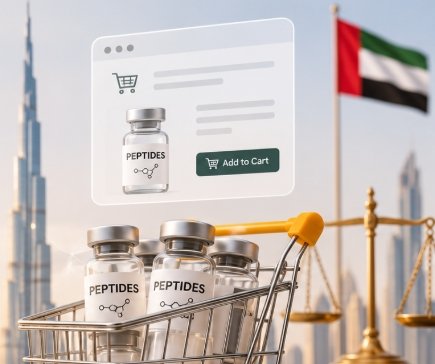
In the healthcare, wellness, and life sciences industry, peptides are receiving a lot of attention. Peptides are short chains of amino acids that can have a range of effects on the body, including anti-ageing, post-injury recovery, boosting metabolism, and anti-inflammation. Online hype has increased demand for peptide therapeutics sold through e-commerce platforms. While this poses a lucrative business opportunity in the UAE, what many miss is that it is a highly regulated sector, where supply depends not just on availability, but on labelling, documentation, and formulation.
A CAUTIONARY EXAMPLE: MELATONIN II
Melanotan II, nicknamed the “Barbie drug”, is a synthetic peptide that mimics alpha-melanocyte-stimulating hormone (α-MSH) to stimulate melanin production, and it is widely promoted online and in gyms as a fast-tanning agent, typically sold as subcutaneous injections or nasal sprays.
The issue is that:
- No major health authority has given its approval.
- Several countries restrict or ban its sale, import, and even advertising.
- Reported side effects range from mole changes that mask early melanoma to muscle breakdown and other serious systemic effects.
The health authority in Abu Dhabi prohibited the importation, distribution and marketing of the drug in July 2025. It is against this backdrop that the UAE’s approach to peptide sales needs to be understood.
CAN GENERAL E-COMMERCE PLATFORMS SELL PEPTIDES IN THE UAE?
The short answer is no.
Under UAE federal law, a wide category of products, including pharmaceuticals, food supplements, cosmetics, healthcare products, and certain chemical ingredients, fall under the definition of a medical product. If a peptide lands in that category, it cannot be sold anywhere, online or offline, without prior approval from the appropriate regulator. This holds true regardless of the business licence the seller holds.
This approval is not just a paperwork formality; the applicant must demonstrate the product’s safety and effectiveness, whether through approvals already granted by recognised reference countries or through clinical assessment, bioequivalence studies, and supporting research data.
This is exactly why so many peptides marketed for anti-ageing, recovery, or performance benefits, including compounds like BPC-157 and TB-500, have not cleared this evidentiary bar in any major jurisdiction, which is precisely why sellers often resort to a “research use only” label rather than seeking registration.
ARE APPROVED PEPTIDES FREELY TRADEABLE?
Even once a product clears marketing approval, it does not become freely tradable.
- General sale still requires the applicant to operate as a MOHAP-licensed medical warehouse, not just any retail entity.
- Certain active ingredients used in these products are treated as controlled substances in their own right, and can only be stored, imported, or distributed by establishments holding a specific licence for that purpose.
- Separately, digital trading law requires online sellers to list only goods that are legally permitted for sale, and to hold back anything needing special approval until that approval exists.
A standard trading or e-commerce activity licence, on its own, resolves none of the above-stated requirements.
THE CONSEQUENCES OF NON-COMPLIANCE BY DIGITAL TRADERS
This is where things get serious and specific. The law imposes penalties, escalating with the severity of the violation:
- The import, export, distribution, marketing, or promotion of medical products, or any raw materials used in their manufacture, or the operation of a pharmaceutical establishment without the required licences, is penalised and can result in imprisonment of six months to two years, a fine of AED 50,000 to AED 200,000, or both.
- A licensed establishment knowingly dealing with an unlicensed one can face imprisonment of 6 months to a year and a fine of AED 50,000–200,000.
Courts can go further still by shutting down the offending establishment (temporarily or permanently), cancelling licences, confiscating products, and charging the violator for their destruction.
The critical point for e-commerce sellers specifically: marketing or promoting an unregistered product is penalised on its own, without even shipping a single unit for exposure to attach.
IS THERE A COMPLIANT WAY TO SELL PEPTIDES ONLINE?
This is feasible, but this will be classified as a different business altogether, not just an added listing.
Selling genuinely pharmaceutical-grade peptides online legitimately means layering a dedicated, product-specific licence on top of whatever general trading activity already exists, tied to operating as a properly licensed pharmacy or medical warehouse, not a general retailer with a broad catalogue. The precise licence, the authority that issues it, and how it interacts with a free zone versus mainland structure is a jurisdiction-and fact-specific question.
CONCLUSION
The issue with selling peptides is more about their classification as a medical product, evidence of their safety and efficacy and how the seller is licensed before even a single unit is sold. Melanotan II shows what happens when they don’t. The penalty structure shows what it costs to get it wrong. And the free zone/mainland question shows that even the starting point for compliance isn’t one-size-fits-all. If your business model involves listing peptide products, cosmetics, therapeutics, or somewhere in between, it is worth having a conversation about determining the regulatory classification of the product, claims, and structure against the current regulatory position, rather than a generic summary of the law.
Authors: Shantanu Mukherjee, Maitreyi Ramdas