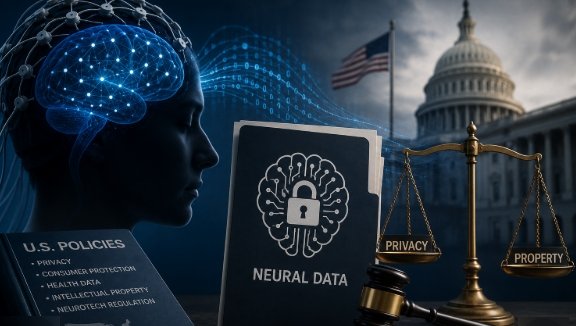
As Neuralink-style brain implants, consumer neurotechnology, and AI-driven neural devices move closer to mainstream adoption, lawmakers are beginning to wonder: who controls the data generated by our brains, and how far should companies be permitted to go in collecting, analysing, and commercialising it?
Regulators in the US are grappling with the reality that neural data may not fit comfortably within existing privacy frameworks. Unlike ordinary consumer information, neural data has the potential to reveal deeply intimate insights about an individual, including emotions, attention patterns, cognitive responses, neurological conditions, and even elements of decision-making behaviour. That arguably makes it one of the most sensitive categories of personal data yet created.
Why is Neural Data Different?
- Conventional privacy legislation organises personal data into familiar types like health records, biometric identifiers, financial information, and location data. Neural data resists easy classification. Depending on the technology involved, that is, whether an implantable brain-computer interface, a consumer wearable, or an application that infers cognitive states from physiological signals, the same category of information may attract entirely different legal treatment.
- This ambiguity is not merely academic. How data is classified determines which rules apply, what consent is required, and how far a company’s obligations extend. For neurotechnology businesses, this classification is one of the first and most consequential issues to resolve, and the answer is rarely straightforward.
The Compliance Patchwork
- The initial regulatory response has come from U.S. states. Several jurisdictions have moved to classify neural data as sensitive information, requiring explicit consent for its collection and use. Others are approaching the question differently by focusing on narrower definitions or addressing specific use cases rather than the category as a whole.
- For companies operating nationally, this creates a familiar but increasingly complex compliance challenge. As more legislatures engage with the issue, the precise implications for any given business will depend on a range of factors, including how the data is defined, where it is collected, how it is processed, and what it is used for. These are not questions with uniform answers because the same product may attract different consent obligations, retention rules, and third-party data restrictions across state lines.
US Federal Policy
- At the federal level, the picture remains unsettled. Proposals such as the MIND Act represent an acknowledgement that existing frameworks, including HIPAA, which does not apply to most consumer neurotechnology products, leave a significant regulatory gap. However, a comprehensive federal compliance framework for neural data does not yet exist.
- What that means in practice is that companies face a dual challenge of managing state-level obligations that already exist, while monitoring and preparing for federal developments that may crystallise those obligations into something more uniform.
Core Legal Crisis
- Consent and disclosure: Whether existing consent mechanisms adequately capture what is being collected and how it may be used are questions that regulators are beginning to scrutinise closely. Where data is collected for one stated purpose and is used for another secondary purpose (e.g., wellness, productivity, device optimisation) that the disclosure did not state, significant exposure is created.
- Security obligations: The sensitivity of neural data raises the stakes around breach prevention, retention practices, and data minimisation in ways that go beyond standard data security requirements.
- Product and marketing claims: Where a device is marketed in ways that imply health or mental-state inference, the intersection of consumer protection law, advertising regulation, and data privacy creates compounding exposure.
Business and Litigation Pressure
- The temptation, given the unsettled state of the law, is to wait for clarity before acting. That approach carries its own risks. State-level obligations are already in force in several jurisdictions, litigation exposure is building as legal definitions diverge, and a company that has not mapped its neural data practices against current requirements is poorly positioned to adapt when federal rules arrive.
- The questions businesses in this space should be asking are about data classification, consent architecture, third-party agreements, retention policies, and product design, which do not have off-the-shelf answers. They require careful analysis of how a specific product works, who it serves, where it operates, and what the data it generates could reveal.
- This is an area where early legal advice pays because the cost of building compliant systems from the outset is considerably lower than retrofitting them under regulatory pressure.
What Comes Next
The emerging regulatory model for neural data is likely to have three layers in the U.S:
- State privacy laws will continue to set the pace, especially where legislatures are willing to classify neural data as sensitive information.
- The FTC may become the central federal actor through studies, enforcement, and guidance if the MIND Act or a similar proposal goes through.
- Broader debates over “neurorights” may push lawmakers toward rules that treat mental privacy as a distinct legal interest rather than just a subset of consumer privacy.
For now, the legal message for companies that handle brain-related data is that they should not assume the old privacy categories are enough. The law is beginning to treat neural data as something fundamentally different, and that difference is likely to shape the next generation of privacy regulation. Early regulatory planning with a technology law firm can help developers identify compliance requirements.
Authors: Shantanu Mukherjee