Summary
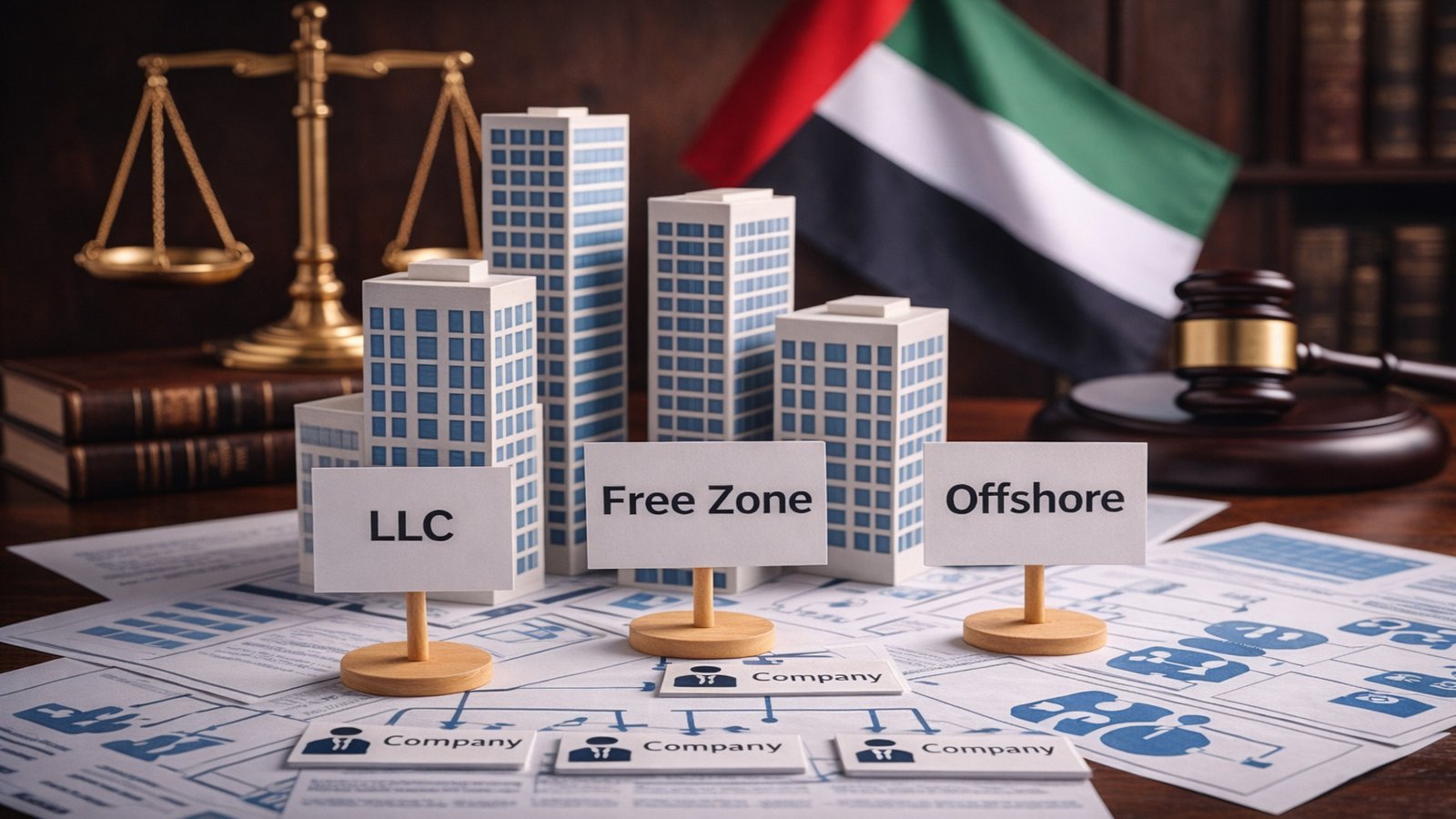
Choosing the right corporate structure in the UAE requires understanding mainland, free zone, and financial free zone options, each with distinct regulatory frameworks, tax implications, and market access rules.
The 2025 amendments to Federal Decree-Law No. 32 of 2021 on Commercial Companies (CCL) introduced enhanced structuring tools for Limited Liability Companies (LLCs), statutory redomiciliation, and clarified free zone entity status (a detailed analysis of which is set out in our earlier article, “All You Need to Know About the Latest Amendments to the UAE Companies Law”).
Key points:
- CCL applies to mainland and standard free zone companies; Dubai International Financial Centre (DIFC) and Abu Dhabi Global Market (ADGM) operate under independent common law frameworks
- 100% foreign ownership permitted in most mainland activities: exceptions for strategic sectors (security, defence, banking, insurance)
- Corporate tax at 9% on taxable income exceeding AED 375,000; Qualifying Free Zone Persons (QFZPs) benefit from 0% rate on qualifying income
- Multinational groups with consolidated global revenues above EUR 750 million subject to 15% Domestic Minimum Top-up Tax from 1 January 2025
What is the Legal Framework for Corporate Structuring in the UAE?
Federal Decree-Law No. 32 of 2021 on Commercial Companies (CCL), effective 2 January 2022 and amended by Federal Decree-Law No. 20 of 2025 (effective 15 October 2025), governs commercial companies on the UAE mainland and foreign company branches.
Free zone companies are regulated by their respective free zone authorities but are now expressly recognized as UAE juridical persons under federal law. Where free zone companies conduct mainland activities, they must comply with the CCL.
Two categories fall outside the CCL’s scope: government-owned companies and companies in DIFC and ADGM, which operate under independent frameworks.
Corporate tax at 9% on taxable income exceeding AED 375,000 applies from 1 June 2023 under Federal Decree-Law No. 47 of 2022. Value added tax at 5% applies under Federal Decree-Law No. 8 of 2017.
Mainland Corporate Structures
Mainland companies are licensed by the relevant Department of Economic Development (DED) and must maintain a physical registered office. Since June 2021, 100% foreign ownership is permitted in most activities. Exceptions remain for strategic sectors under Cabinet Resolution No. 55 of 2021.
Limited Liability Company (LLC): The most widely used structure for mainland operations, formed by one or more shareholders with liability limited to capital contribution. No prescribed minimum share capital under the CCL for most activities, though DEDs may impose thresholds for specific licenses.
The 2025 amendments permit multiple share classes with differentiated voting rights, economic entitlements, and redemption features. Drag-along and tag-along rights can be embedded in the memorandum of association. Deadlock resolution mechanisms and succession arrangements can be built into constitutional documents.
This structure is particularly attractive for entrepreneurs considering business setup in UAE with long-term domestic operations, as it provides flexibility while ensuring full UAE market access. It suits retail, trading, services, technology, and consulting firms operating in the UAE domestic market.
Sole Proprietorship: Single-owner structure available for commercial activities to UAE nationals and GCC citizens, and for professional activities to licensed practitioners. Owner carries unlimited personal liability. Simple and inexpensive but unsuitable for meaningful commercial risk or external investment.
Public Joint Stock Company (PJSC) and Private Joint Stock Company (PrJSC): PJSC requires minimum five shareholders, AED 30 million share capital, and stock exchange listing. Only PJSCs may undertake banking and insurance under the CCL. Regulated by the Ministry of Economy and Securities and Commodities Authority with extensive governance obligations.
PrJSC requires minimum two shareholders and AED 5 million share capital without listing requirement. The 2025 amendments enable PrJSCs to raise capital through private placements. Suit large-scale enterprises in banking, insurance, infrastructure, and capital-intensive industries.
Branch of a Foreign Company: Foreign companies may establish mainland branches for activities consistent with the parent. No independent legal personality; parent bears full liability. No minimum capital requirement. Suits multinational firms in construction, engineering, and professional services.
Free Zone Corporate Structures
The UAE has over 40 free zones offering 100% foreign ownership, customs exemptions, and streamlined incorporation. Core structures are the Free Zone Limited Liability Company (FZ LLC) for multiple shareholders and Free Zone Establishment (FZE) for single shareholders.
Free zone entities historically operated only within the zone or internationally, with limited mainland access. Some zones, particularly in Dubai, now offer dual licensing for limited mainland access, though this carries additional regulatory requirements and potential tax implications.
QFZPs benefit from 0% corporate tax on qualifying income. Requirements include adequate free zone substance (assets and employees), income from qualifying activities, non-qualifying income not exceeding the lower of 5% of total revenue or AED 5 million, and transfer pricing compliance. Substantial mainland activities typically constitute non-qualifying income and can result in loss of QFZP status for minimum five tax periods.
DIFC and ADGM Corporate Structures
The DIFC and ADGM are financial free zones that operate entirely outside the scope of the CCL. Both are governed by their own legislation based on English common law and have independent courts. They are well suited to financial services businesses, funds, family offices, and holding structures.
DIFC Structures: The DIFC offers several entity types including private companies, public companies, limited liability partnerships, foundations, and branches. Of particular relevance is the Prescribed Company, introduced under the DIFC Prescribed Company Regulations 2024, which replaced prior Special Purpose Vehicle (SPV) frameworks.
A Prescribed Company is a passive holding vehicle, incorporated as a private company limited by shares, designed to ring-fence assets and liabilities. It cannot employ staff or conduct active commercial operations. Since the 2024 regulations, any person globally may establish a Prescribed Company provided a director who is an employee of a Dubai Financial Services Authority (DFSA)-registered Corporate Service Provider is appointed. It is used widely for real estate holding, intellectual property ownership, co-investment structures, and family wealth planning. Incorporation and annual licensing costs are considerably lower than for full commercial entities in DIFC.
ADGM Structures: ADGM offers an equivalent vehicle in the form of its own SPV structure, which operates as a passive holding company under a common law framework. Key differences from the DIFC Prescribed Company include: ADGM SPVs must appoint a Corporate Service Provider and cannot hold dedicated office space, whereas DIFC Prescribed Companies may share office space with a DIFC-affiliated entity. The choice between them generally turns on asset location, existing group structure, and the specific regulatory environment most suitable for the intended activity.
For operating businesses in financial services, asset management, or fintech, DIFC and ADGM offer regulatory environments through the DFSA and Financial Services Regulatory Authority (FSRA) respectively that are distinct from and generally more sophisticated than standard free zone licensing.
How Do I Choose the Right Structure?
Market Access: Mainland LLCs provide unrestricted UAE market access and government contract eligibility. Free zone entities access international markets efficiently but require careful planning for mainland access without compromising tax status.
Tax Planning: The QFZP 0% rate requires strict ongoing compliance. Businesses expecting significant onshore revenues should model tax positions before committing to free zone structures. DIFC and ADGM offer efficient holding vehicles under common law frameworks.
Redomiciliation: The 2025 CCL amendments allow companies to transfer registration between mainland and free zone jurisdictions without liquidation, preserving legal identity and contractual continuity.
Regulated Sectors: Healthcare, financial services, education, and telecommunications require additional sector regulator approvals.
Multinational Groups: Groups with consolidated global revenues above EUR 750 million face a 15% Domestic Minimum Top-up Tax from 1 January 2025 under Federal Decree-Law No. 60 of 2023.
Key Takeaways
The 2025 CCL amendments enhanced mainland LLC flexibility through multiple share classes, drag-along and tag-along rights, and statutory redomiciliation, making mainland structures more competitive with free zone options.
Mainland LLCs provide unrestricted UAE market access and suit investment-backed businesses with enhanced structuring tools. Free zone entities offer 0% corporate tax for QFZPs but require strict substance and income compliance. DIFC and ADGM provide common law frameworks for financial services, funds, and passive holding structures.
Key considerations include tax planning (9% standard rate versus 0% QFZP rate with conditions), market access requirements, regulatory approvals for specific sectors, and redomiciliation flexibility. Large multinational groups must consider the 15% Domestic Minimum Top-up Tax from 1 January 2025.
Founders and investors should obtain specialist advice from the best corporate law firm and lawyers in UAE to navigate regulatory and tax implications, particularly for regulated sectors, complex structures, or businesses expecting to evolve their market focus.
Authors: Shantanu Mukherjee, Alan Baiju