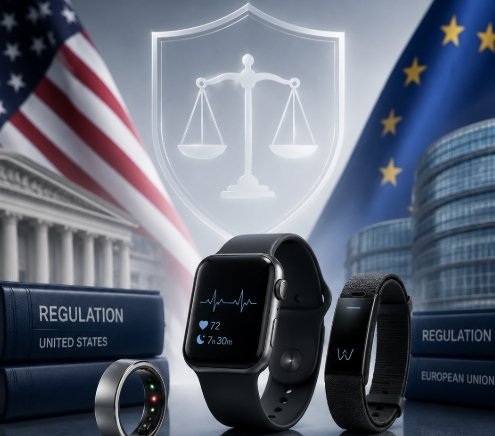
An Apple Watch, an Oura Ring, or a Whoop band sits at the centre of a long-running regulatory question: when does a lifestyle gadget that becomes a regulated medical device? In 2025 and 2026, both the United States and the European Union sharpened their answers, and the two systems are moving in noticeably different directions even as they converge on the same underlying test.
Why is a fitness tracking device’s ‘intended purpose’ important?
Both the US and EU regimes are based on the shared principle that a product’s regulatory classification is determined by its intended purpose, rather than by the software on which it runs. Two identical products can be an unregulated wellness tool or a regulated medical device, depending entirely on how they are described, labelled, and marketed.
US Framework: Intended Purpose under the FDA
In the US, the Federal Food, Drug, and Cosmetic Act defines a “device” as a product intended to perform diagnosis, cure, mitigation, treatment, or prevention of disease. The 21st Century Cures Act carved out a “wellness exception” for low-risk software intended only to maintain or encourage a healthy lifestyle and unrelated to disease.
EU Framework: Intended Purpose under MDR
The EU’s Medical Device Regulation (MDR, Regulation (EU) 2017/745) similarly provides that qualification as “medical device software” depends on the manufacturer’s intended purpose, irrespective of the software it runs on, which was reinforced by the Medical Device Coordination Group (MDCG) revision of the MDCG 2019-11, in June 2025.
Which devices does the FDA treat as non-regulated General Wellness products?
On 6 January 2026, the FDA updated its General Wellness guidance to address enforcement discretion for low-risk devices and clinical decision support software. The updated approach permits non-invasive, sensor-based wearables, including those estimating heart rate and blood glucose, to claim general wellness status if they avoid disease, diagnostic, or clinical-management claims and present minimal safety risk. However, the guidance retains a few critical limitations which entrepreneurs will need to consider carefully. Parallel to this guidance, the FDA’s new TEMPO pilot program (announced December 2025) offers a structured pathway for manufacturers of certain unauthorised digital health devices to generate real-world evidence under CMS ACCESS payment models in exchange for participation in supervised data collection and acceptance of targeted enforcement discretion. The enforcement landscape remains complex, as illustrated by the agency’s July 2025 warning letter to Whoop regarding its blood pressure estimation feature and the subsequent class action litigation that followed. These developments underscore that regulatory classification of wearable functions remains contested territory requiring careful legal assessment, making guidance from a healthcare & life sciences law firm particularly valuable.
Market Illustration of Regulatory Strategies:
The market has effectively split into two strategies, and the divide is instructive.
Apple has pursued formal authorisation feature by feature for functions that unambiguously touch disease. Its ECG app received FDA De Novo classification in 2018; its AFib History feature obtained 510(k) clearance in 2022; and its sleep apnoea notification feature was cleared in 2024. Crucially, Apple pairs each clearance with carefully limited labelling, for example, the ECG output is “not intended to replace traditional methods of diagnosis,” and the sleep apnoea feature cannot provide a standalone diagnosis. Apple thus operates a hybrid device, with regulated medical functions sitting alongside unregulated wellness ones on the same hardware. The classification is clear; features that detect arrhythmia or sleep apnoea are squarely within categories the FDA actively regulates, so certification is the only viable route to make the claims at all.
Aktiia (now Hilo) offers a contrasting lesson on blood pressure. Days before the Whoop letter, the Swiss company secured 510(k) clearance for its over-the-counter cuffless blood pressure monitor. Hilo broadly uses the same PPG-based approach that Whoop deployed, but by seeking authorisation, the same physiological measurement that was lawful for one company was an enforcement target for the other.
Oura and Whoop have historically anchored themselves in the wellness category, leaning on recovery, sleep, and strain framing to stay outside device regulation. That positioning is durable for genuinely lifestyle-oriented metrics, but the Whoop episode demonstrates its limits: once a feature strays into a metric the regulator treats as inherently diagnostic, wellness branding and user disclaimers will not save it.
How does the EU regulate Fitness Wearables?
The EU’s regulation of wearables operates under a binary classification model: software and devices either qualify as medical devices under the Medical Device Regulation (MDR) or they do not, with no middle ground or published enforcement discretion policy. Whether a wearable function falls within the medical device definition is determined solely by intended purpose; it is risk-classified under MDR Annex VIII (typically Class IIa or higher for diagnostic and monitoring functions), triggering requirements for regulatory involvement, clinical evaluation, and CE marking. Beyond this direct scope, MDR Annex XVI permits the EU to bring specified non-medical products within the regulation based on their risk profile and technological capabilities. AI-enabled wearables now face dual-compliance obligations under both the MDR and the EU AI Act, with machine-learning analytics subject to simultaneous technical-documentation requirements under both frameworks. Regulatory obligations intensified further with mandatory EUDAMED UDI device registration effective 28 May 2026 and proposed MDR revisions aimed at greater integration and transparency.
How do the US and EU regulatory regimes differ when it comes to Fitness Wearables?
The two systems now sit in interesting tension. The US is signalling regulatory flexibility at the level of guidance and pilot programmes, while its device centre enforces aggressively against features that cross into actively regulated territory. The EU offers no comparable wellness off-ramp but is steadily rationalising its framework and folding in AI obligations. The common thread is that, in both markets, the intended-use determination is made on the totality of the evidence, which is to say, app-store descriptions, user-interface design, and notifications all count, not merely the formal disclaimer buried in the terms. Businesses developing digital health products often work with technology lawyers to navigate these evolving regulatory requirements across multiple jurisdictions.
Authors: Shantanu Mukherjee